The Environment of Business III
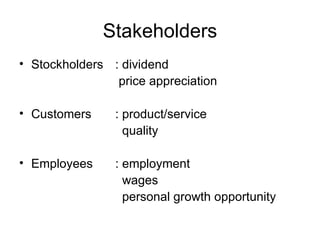
Stakeholders Stockholders  : dividend   price appreciation Customers : product/service   quality Employees : employment   wages   personal growth opportunity
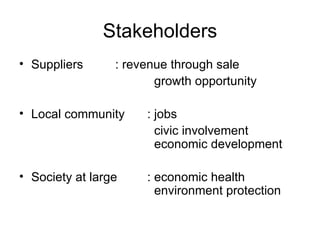
Stakeholders Suppliers : revenue through sale   growth opportunity Local community : jobs   civic involvement   economic development Society at large : economic health    environment protection
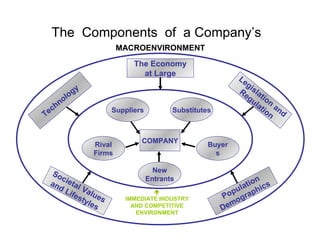
The  Components  of  a Company’s  MACROENVIRONMENT Legislation and Regulation Societal Values and Lifestyles Population Demographics Technology The Economy at Large COMPANY Suppliers Substitutes Buyers New Entrants Rival Firms  IMMEDIATE INDUSTRY AND COMPETITIVE ENVIRONMENT
Political and Legal Deregulation Repeal of Glass-Steigall Act 1999 Tort Reform Disabilities Act
Economy Interest rate Exchange rate Unemployment Trend in GDP
Technology Reduced height of entry barrier Biotechnology Pollution/Global Warming Wireless communication Miniaturization
Socio-cultural Health Consciousness Postponement of family formation More women in workforce Greater concern for environment
Demography Aging population  Rising affluence Greater disparities in income levels  Geographic distribution of    population
Global WTO Currency Exchange Rate Emergence of China and India
#1. Dominant Economic Traits Market Size Scope of Competition (Local, Regional, National, Global) Industry Growth Cycle (Early, Takeoff, Mature, Stagnant, Decline) Number of Rivals and their relative sizes Number of Buyers and their relative sizes Prevalence of Backward and Forward Linkage Ease of Entry and Exit Pace of Technological Change Learning Curve Effect Capital Requirement Profitability (above/below par)
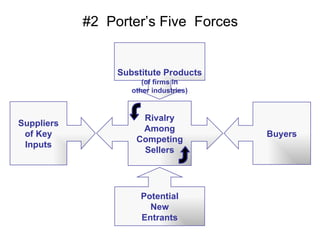
#2  Porter’s Five  Forces Substitute Products (of firms in other industries) Suppliers of Key Inputs Buyers Potential New Entrants Rivalry Among Competing Sellers
Bargaining Power of Buyers - Many small companies and few buyers,  Large buyers - Buyers can switch orders between  suppliers enabling them to play one supplier against another - Vertical integration is a feasible option
Suppliers - Product has few substitutes and are important to the buyers - Products are differentiated to the extent that buyers cannot easily switch - Threat of vertical integration  - Buying companies cannot threaten with backward integration
Rivalry - Demand conditions  : growing/declining - Exit barriers : high/low - Competitive structure : fragmented,    consolidated
Substitutes - Products serving similar consumer needs   sugar vs artificial sweetener taxi vs bus private vs public university
Threat of Entry - Brand loyalty - Economies of scale - Entry barriers - Govt. regulation
Generic Competitive Strategies Two basic types:  - Low cost - Differentiation Three generic strategies resulting from the scope of application :  - Cost - Differentiation - Focus.
Generic Competitive Strategies COST leadership  promoted by means such as frugality,  discipline and attention to details.  DIFFERENTIATION facilitated by a culture of encouraging  innovation, individualism and risk taking.
Cost  OR  Differentiation An organizational structure that is supportive of cost leadership can be ruinous for differentiation  e.g. tight control system  pursuit of scale economies  dedication to learning curve.
Stuck in the Middle Being all things to all people can be a recipe for disaster and such firms cannot have a sustainable competitive advantage. Whatever strategy is chosen, it has to be sustainable.  This can be made through making it difficult for imitators by putting up a moving target.
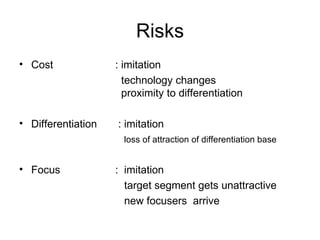
Risks Cost  : imitation   technology changes    proximity to differentiation Differentiation  : imitation   loss of attraction of differentiation base Focus   :  imitation   target segment gets unattractive   new focusers  arrive

Environ 3

  • 1.
    The Environment ofBusiness III
  • 2.
    Stakeholders Stockholders : dividend price appreciation Customers : product/service quality Employees : employment wages personal growth opportunity
  • 3.
    Stakeholders Suppliers :revenue through sale growth opportunity Local community : jobs civic involvement economic development Society at large : economic health environment protection
  • 4.
    The Components of a Company’s MACROENVIRONMENT Legislation and Regulation Societal Values and Lifestyles Population Demographics Technology The Economy at Large COMPANY Suppliers Substitutes Buyers New Entrants Rival Firms  IMMEDIATE INDUSTRY AND COMPETITIVE ENVIRONMENT
  • 5.
    Political and LegalDeregulation Repeal of Glass-Steigall Act 1999 Tort Reform Disabilities Act
  • 6.
    Economy Interest rateExchange rate Unemployment Trend in GDP
  • 7.
    Technology Reduced heightof entry barrier Biotechnology Pollution/Global Warming Wireless communication Miniaturization
  • 8.
    Socio-cultural Health ConsciousnessPostponement of family formation More women in workforce Greater concern for environment
  • 9.
    Demography Aging population Rising affluence Greater disparities in income levels Geographic distribution of population
  • 10.
    Global WTO CurrencyExchange Rate Emergence of China and India
  • 11.
    #1. Dominant EconomicTraits Market Size Scope of Competition (Local, Regional, National, Global) Industry Growth Cycle (Early, Takeoff, Mature, Stagnant, Decline) Number of Rivals and their relative sizes Number of Buyers and their relative sizes Prevalence of Backward and Forward Linkage Ease of Entry and Exit Pace of Technological Change Learning Curve Effect Capital Requirement Profitability (above/below par)
  • 12.
    #2 Porter’sFive Forces Substitute Products (of firms in other industries) Suppliers of Key Inputs Buyers Potential New Entrants Rivalry Among Competing Sellers
  • 13.
    Bargaining Power ofBuyers - Many small companies and few buyers, Large buyers - Buyers can switch orders between suppliers enabling them to play one supplier against another - Vertical integration is a feasible option
  • 14.
    Suppliers - Producthas few substitutes and are important to the buyers - Products are differentiated to the extent that buyers cannot easily switch - Threat of vertical integration - Buying companies cannot threaten with backward integration
  • 15.
    Rivalry - Demandconditions : growing/declining - Exit barriers : high/low - Competitive structure : fragmented, consolidated
  • 16.
    Substitutes - Productsserving similar consumer needs sugar vs artificial sweetener taxi vs bus private vs public university
  • 17.
    Threat of Entry- Brand loyalty - Economies of scale - Entry barriers - Govt. regulation
  • 18.
    Generic Competitive StrategiesTwo basic types: - Low cost - Differentiation Three generic strategies resulting from the scope of application : - Cost - Differentiation - Focus.
  • 19.
    Generic Competitive StrategiesCOST leadership promoted by means such as frugality, discipline and attention to details. DIFFERENTIATION facilitated by a culture of encouraging innovation, individualism and risk taking.
  • 20.
    Cost OR Differentiation An organizational structure that is supportive of cost leadership can be ruinous for differentiation e.g. tight control system pursuit of scale economies dedication to learning curve.
  • 21.
    Stuck in theMiddle Being all things to all people can be a recipe for disaster and such firms cannot have a sustainable competitive advantage. Whatever strategy is chosen, it has to be sustainable. This can be made through making it difficult for imitators by putting up a moving target.
  • 22.
    Risks Cost : imitation technology changes proximity to differentiation Differentiation : imitation loss of attraction of differentiation base Focus : imitation target segment gets unattractive new focusers arrive